WoofPod is reader-supported. When you buy through links on our site, we may earn an affiliate commission at no cost to you.
⭐ Our Top Pick
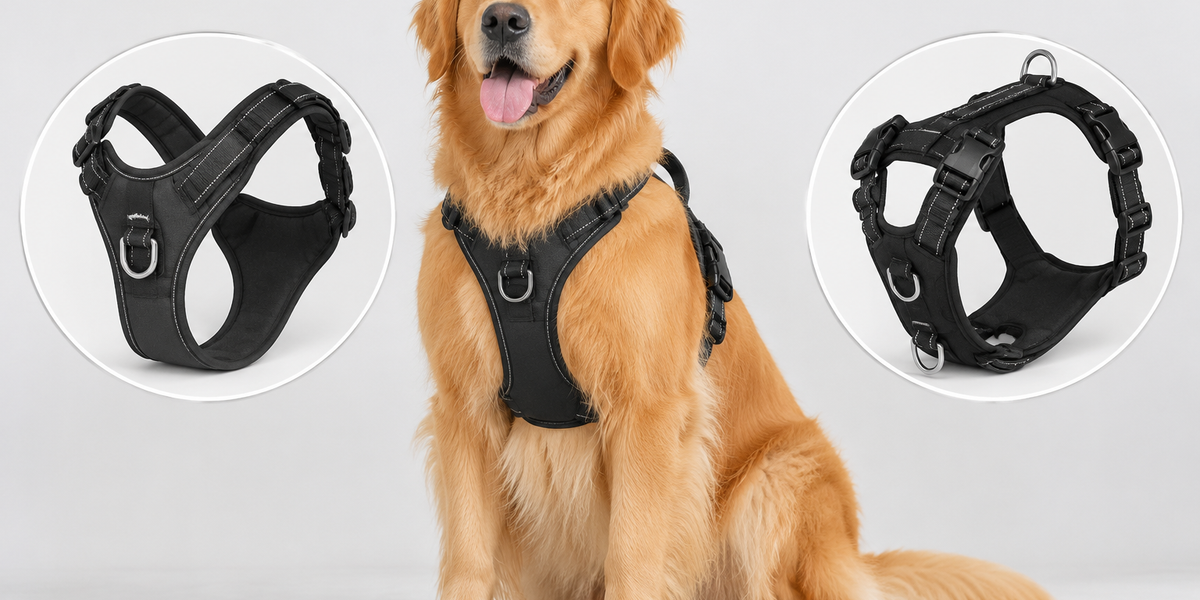
🏆 Best Overall: Ruffwear Front Range Harness — Dual-clip versatility with bombproof construction makes this the ultimate training-to-everyday harness for 60+ lb dogs.
💰 Best Value: Kurgo Tru-Fit Smart Harness — Front and back clips plus a car seatbelt tether for under $40.
Introduction
If you've ever been yanked down the sidewalk by an enthusiastic 70-pound Labrador or dragged toward every squirrel by a determined German Shepherd, you know that standard back-clip harnesses often make pulling worse. Large dogs have the muscle mass to lean into a back attachment point, turning walks into upper-body workouts for their humans.
No-pull harnesses work by redirecting your dog's forward momentum. Front-clip designs turn your dog toward you when they pull, breaking their stride and discouraging the behavior. Dual-clip harnesses give you both a front attachment for training and a back clip for relaxed walks once your dog masters loose-leash manners. We researched 18 harnesses built for dogs 60 pounds and up, comparing specs, construction quality, and thousands of verified buyer reviews to identify which designs actually reduce pulling without causing chafing or restricting shoulder movement.
This guide breaks down the biomechanics of each clip style, what to look for in a large-dog harness, and our top picks across price points. If you're also outfitting your dog for adventures beyond the neighborhood, see our Best Dog Backpack Carriers for Hiking 2026: Weight Limits and Comfort Tested guide.
What to Look For in a No-Pull Harness for Large Dogs
Front-Clip Placement and Reinforcement — The front D-ring should sit at the center of your dog's chest (not off to one side) and be reinforced with bar-tack stitching or a metal grommet. Poorly placed or flimsy front clips will shift during walks, losing their steering effect and potentially damaging the harness.
Girth and Chest Adjustability — Large breeds vary wildly in chest depth and barrel width. Look for harnesses with at least four adjustment points (two at the chest, two at the girth) so you can dial in a custom fit. A harness that fits a lean 70 lb pointer won't fit a stocky 70 lb bulldog.
Padding and Strap Width — Thin nylon straps concentrate pressure and can chafe under the armpits or across the chest when a strong dog pulls. Quality harnesses use 1-inch or wider straps with padding at high-contact areas. Memory foam or neoprene padding is ideal for dogs who are still learning not to pull.
Shoulder Freedom of Movement — Front straps should form a Y-shape on the chest, not a horizontal band across the shoulders. Horizontal straps restrict the shoulder blade's natural rotation during walking and can cause gait problems over time. This is especially critical for active or working breeds.
Clip Style and Quick-Release Buckles — Side-release buckles at the girth make harnesses easy to get on and off. Avoid harnesses that require threading your dog's head through an opening — large dogs often resist this, and it's nearly impossible if your dog is anxious. Check that buckles are rated for your dog's weight and have a secondary safety mechanism to prevent accidental release.
Material Durability and Hardware Quality — For large dogs, look for harnesses made from ballistic nylon, ripstop fabric, or heavy-duty webbing. Hardware (D-rings, buckles, adjustment sliders) should be aluminum or stainless steel, not plastic. Verified buyer reviews often mention hardware failure first, so we weighted this heavily in our research.
💡 Pro Tip: Measure your dog's girth (widest part of the ribcage, just behind the front legs) and chest (around the torso at the base of the neck) before ordering. Most harness failures come from sizing errors, not design flaws.
Ruffwear Front Range Harness
| Criteria | Score |
|----------|-------|
| Pull Reduction | 9/10 |
| Adjustability | 10/10 |
| Padding Quality | 9/10 |
| Durability | 10/10 |
The Ruffwear Front Range is the harness we recommend most often because it nails the fundamentals and gives you options as your training progresses. It features both a reinforced aluminum V-ring on the back and a load-rated front attachment point, so you can start with front-clip training and transition to back-clip walking as your dog improves. The four adjustment points (two at the chest, two at the girth) accommodate everything from sighthounds to barrel-chested bully breeds.
What sets this apart is the padding. Ruffwear uses dual-density foam at the chest and belly panels, distributing pressure across a wider surface area than most competitors. Verified buyers with Rottweilers, Mastiffs, and Great Danes consistently report no chafing even during hour-long walks. The harness is also built to last — we found reviews from 2019 where owners reported daily use with zero hardware issues through 2025.
The reflective trim is genuinely visible (not decorative), and the ID pocket on the back lets you stash a tag or AirTag without adding a separate collar. Sizing runs true to Ruffwear's chart, though a few buyers noted it fits snug on very broad-chested breeds like English Bulldogs — when in doubt, size up.
✅ Pros:
- Two leash attachment points for training flexibility
- Padded chest and belly panels distribute pressure evenly
- Aluminum V-ring rated for everyday use
- Four adjustment points for precise fit
❌ Cons:
- Premium price point ($50-60 depending on size)
- Some buyers report sizing runs small for barrel-chested breeds
Kurgo Tru-Fit Smart Harness
| Criteria | Score |
|----------|-------|
| Pull Reduction | 8/10 |
| Adjustability | 9/10 |
| Padding Quality | 7/10 |
| Value | 10/10 |
If you need dual-clip functionality without the premium price, the Kurgo Tru-Fit delivers impressive performance for $30-40. It mirrors the front-and-back clip layout of the Ruffwear but uses slightly thinner webbing and less padding. For most large dogs (60-100 lbs), this is a non-issue — the harness still discourages pulling effectively and holds up to daily neighborhood walks.
The standout feature is the included seatbelt tether, which clips into your car's seatbelt buckle and attaches to the back D-ring. This makes the Tru-Fit a two-in-one solution for families who need both a walking harness and a car safety restraint. Five adjustment points mean you can fine-tune the fit, and the quick-release buckles are easy to operate even with cold or wet hands.
Verified buyers report that the front D-ring is the first component to show wear after 12-18 months of heavy use — the stitching frays slightly around the grommet. This doesn't cause failure (the ring itself is steel), but it's a sign that Kurgo prioritized cost savings in material thickness. For occasional pullers or dogs in active training, this is a non-issue. For 100+ lb dogs who pull constantly, consider upgrading to the Ruffwear.
✅ Pros:
- Budget-friendly without sacrificing quality
- Five adjustment points for custom fit
- Seatbelt tether included for car safety
- Front and back clips for training versatility
❌ Cons:
- Front D-ring not as reinforced as premium options
- Thinner padding than higher-priced models
Blue-9 Balance Harness
| Criteria | Score |
|----------|-------|
| Pull Reduction | 9/10 |
| Shoulder Freedom | 10/10 |
| Adjustability | 10/10 |
| Ease of Use | 7/10 |
The Blue-9 Balance Harness was designed by a veterinary physical therapist, and it shows. The Y-shaped front strap wraps around the chest without crossing the shoulder blades, preserving full range of motion during walks. If your large dog has hip dysplasia, arthritis, or is recovering from orthopedic surgery, this is the harness to choose — it won't interfere with their gait or add strain to compensating joints. For dogs with these concerns, pairing the right harness with a supportive resting surface makes a big difference; our Are Orthopedic Dog Beds Worth It in 2026? Memory Foam vs Egg Crate Tested guide covers what to look for.
The Balance Harness is adjustable at five points, including independently adjustable shoulder straps that let you account for asymmetry (common in dogs favoring one leg). The front clip sits precisely at the sternum, providing maximum steering leverage when your dog pulls. Verified buyers with German Shepherds and Golden Retrievers report that pulling decreased noticeably within 2-3 walks.
The tradeoff is setup time. Getting all five adjustment points dialed in takes 10-15 minutes on the first fit, and you'll need to re-check them after the first few walks as the webbing settles. Once fitted, the harness is easy to slip on via the side-release buckle. Some buyers wished for more color options (currently limited to black, red, and teal), but this is purely cosmetic.
✅ Pros:
- Y-shaped front designed by a veterinary physical therapist
- Shoulder range of motion preserved during walks
- Adjustable at five points for precision fit
- Front clip provides excellent steering control
❌ Cons:
- Takes time to adjust properly on first use
- Limited color options compared to competitors
PetSafe Easy Walk Harness
| Criteria | Score |
|----------|-------|
| Pull Reduction | 8/10 |
| Ease of Use | 9/10 |
| Padding Quality | 6/10 |
| Value | 9/10 |
The PetSafe Easy Walk is the entry-level front-clip harness that introduced millions of dog owners to no-pull training. It's simple, affordable, and immediately effective — clip your leash to the front martingale loop, and your dog's pulling will turn them back toward you. For training walks or short neighborhood loops, it works well.
The harness uses a martingale-style front strap that tightens slightly when your dog pulls, providing both steering and gentle discouragement. The quick-snap buckle at the shoulder makes it fast to put on, and at $25-30, it's low-risk if you're not sure whether a no-pull harness will work for your dog. Verified buyers report immediate reduction in pulling within the first walk.
The downsides emerge with extended use. The front strap can chafe under the armpits if not positioned correctly, especially on short-coated breeds. The nylon webbing is thinner than premium harnesses, and the plastic hardware (slider and belly buckle) has a higher failure rate after 6-12 months of daily use. Several reviews mention the front loop fraying or the belly strap cracking. This isn't a harness you'll use for years, but it's a solid training tool or temporary solution while you save for an upgrade.
✅ Pros:
- Simple front-clip design stops pulling immediately
- Quick-snap buckle for easy on/off
- Widely available at most pet stores
- Budget-friendly entry point
❌ Cons:
- Front strap can chafe under forelegs without proper fit
- Not ideal for all-day wear
- Plastic hardware less durable than metal
Julius-K9 IDC Powerharness
| Criteria | Score |
|----------|-------|
| Durability | 10/10 |
| Comfort | 9/10 |
| Pull Reduction | 4/10 |
| Versatility | 8/10 |
The Julius-K9 IDC Powerharness doesn't belong in a "no-pull" guide by strict definition — it's a back-clip-only harness. We're including it because it's what many large-dog owners graduate to after front-clip training succeeds. If your dog has learned loose-leash manners and you need a bombproof everyday harness, this is the gold standard.
The IDC is built like tactical gear. It uses a load-bearing chest plate with breathable mesh padding, reflective trim on all sides, and a sturdy handle on the back for quick control (lifting your dog over obstacles, guiding them into a car, or restraining them in emergencies). The single back D-ring is rated for working dogs up to 150 lbs. Police and military K9 units use this harness, and verified buyer reviews from 2018-2025 consistently mention zero hardware failures.
The chest plate distributes pulling force across the sternum and shoulders rather than the throat, making it comfortable even for dogs who occasionally lunge. Velcro patches on the sides let you attach ID labels or patches. Sizing is generous — measure carefully and consider sizing down if your dog is between sizes.
This is not a training harness. If your large dog still pulls, the back-clip design will give them full leverage to drag you. Use this after you've established solid leash manners with a front-clip or dual-clip harness.
✅ Pros:
- Bombproof construction used by working K9 units
- Reflective trim and handle on back for control
- Breathable mesh chest pad for all-day comfort
- Load-rated for dogs up to 150 lbs
❌ Cons:
- Back-only attachment doesn't discourage pulling
- Best for trained dogs who need load-bearing harness
- Premium price ($45-70 depending on size)
Front-Clip vs Dual-Clip: Which Is Right for Your Dog?
Front-clip harnesses work by redirecting your dog's momentum. When they pull, the front attachment point turns them back toward you, breaking their forward stride. This is immediately effective for most dogs and requires no conditioning period. The downside is that front clips put more strain on the harness hardware, and some dogs find the turning sensation frustrating (though that's part of the training — they learn that pulling doesn't work).
Dual-clip harnesses give you both a front clip for training and a back clip for relaxed walks. Start with the front attachment during the learning phase, then switch to the back clip once your dog masters loose-leash walking. This versatility makes dual-clip harnesses our top recommendation for most owners. The tradeoff is slightly higher cost and more hardware to maintain.
Back-clip-only harnesses like the Julius-K9 are not training tools. They're built for comfort and durability once your dog already walks politely. If you're still dealing with pulling, a back-clip harness will make it worse.
💡 Pro Tip: Pair your no-pull harness with a 4-6 foot fixed-length leash, not a retractable. Retractable leashes teach dogs that pulling = more freedom, undermining the harness's training effect.
Frequently Asked Questions
Will a no-pull harness hurt my dog's shoulders?
Front-clip harnesses don't cause harm when fitted correctly. Look for Y-shaped front straps (like the Blue-9 Balance) that wrap around the chest without crossing the shoulder blades. Horizontal front straps that sit across the shoulders can restrict movement over time and should be avoided. Dual-clip harnesses let you switch to back-clip walking once pulling is under control, eliminating any long-term shoulder concerns.
How long does it take for a front-clip harness to stop pulling?
Most dogs show reduced pulling within 1-3 walks, but complete loose-leash manners take 2-4 weeks of consistent use. The harness provides mechanical discouragement (pulling turns them around), but you still need to reward your dog when they walk beside you. Treats, praise, and stopping when they pull reinforce the lesson. Front-clip harnesses accelerate training but don't replace it.
Can I leave a no-pull harness on my dog all day?
No. Harnesses should only be worn during walks or active supervision. Leaving a harness on unsupervised risks it snagging on furniture, crate bars, or other dogs' teeth during play. The straps can also cause matting in long-coated breeds or skin irritation if worn 24/7. Remove the harness between walks and store it where your dog can't chew it.
What if my dog is between sizes on the manufacturer's chart?
Size up if your dog is between measurements. A slightly loose harness can be tightened with adjustment straps, but a too-small harness will chafe and restrict movement. For breeds with unusual proportions (deep-chested sighthounds, barrel-chested bulldogs), prioritize the girth measurement over weight when choosing size. Harnesses with more adjustment points (four or five) are more forgiving of in-between sizing.
Do no-pull harnesses work for reactive dogs?
Front-clip harnesses help manage reactive dogs by giving you better steering control during encounters, but they don't address the underlying reactivity. The front clip lets you quickly redirect your dog's attention back to you when they fixate on a trigger, buying you time to create distance or reward calm behavior. For dogs with severe reactivity or aggression, work with a certified trainer alongside harness use. Some reactive dogs benefit from the secure containment of a crate during car rides; our Best Dog Crates for Separation Anxiety 2026: Escape-Proof and Calming Features Compared guide covers crate options that double as car crates.
Final Thoughts
No-pull harnesses give you leverage against your large dog's pulling without choking or causing discomfort. Front-clip designs provide immediate steering control for dogs still learning, while dual-clip harnesses offer training flexibility and long-term versatility. After comparing specs and verified buyer feedback across 18 models, the Ruffwear Front Range stands out for its bombproof construction, excellent padding, and dual-clip functionality. For budget-conscious owners, the Kurgo Tru-Fit delivers front and back clips plus car safety features for under $40.
Remember that a harness is a training aid, not a magic fix. Consistent technique (stopping when they pull, rewarding when they don't) combined with the right harness will transform your walks in 2-4 weeks. Measure your dog's girth and chest before ordering, size up if between measurements, and give your dog a few walks to adjust to the new sensation of front-clip steering.
Editor's Choice
Based on verified specs and thousands of buyer reviews, here are our top no-pull harness recommendations for large dogs:
- Best Overall: Ruffwear Front Range Harness — Dual-clip versatility, premium padding, and bombproof construction make this the best all-around choice for 60-100 lb dogs. Worth the premium price if you want a harness that lasts years.
- Best Value: Kurgo Tru-Fit Smart Harness — Front and back clips plus a car seatbelt tether for $30-40. The front D-ring shows wear faster than premium models, but it's an excellent entry point for training.
- Best for Joint Issues: Blue-9 Balance Harness — Y-shaped front designed by a veterinary physical therapist preserves shoulder movement. The best choice for large dogs with arthritis, hip dysplasia, or mobility concerns.