This post contains affiliate links. If you buy through them, WoofPod may earn a small commission at no extra cost to you.
⭐ Our Top Pick
🏆 Best Overall: PetFusion Digital Pet Scale — You can't feed by weight without knowing the weight; this scale makes portion math accurate and repeatable.
💰 Best Value: Kitchen Tour Digital Kitchen Scale — A $14 gram scale converts vague 'cups' into real calories, the cheapest way to stop overfeeding.
Introduction
"How much should I feed my dog?" is the most common nutrition question we get at WoofPod — and the honest answer is: it depends on weight, life stage, activity, and the calorie density of the food in the bowl. A 40-lb couch potato and a 40-lb working collie need very different portions, and the bag's feeding chart is only a starting point.
In this 2026 guide, we've compiled a vet-style feeding chart by weight, a simple calorie calculator you can run in your head, and the measuring tools that make portions consistent. Everything here is based on published veterinary nutrition guidelines (including WSAVA and AAHA body-condition scoring) and verified buyer reviews of the products we recommend — not on lab testing we didn't perform.
By the end, you'll know your dog's resting energy requirement, how to adjust for activity and age, and how to tell whether the portion is actually right by checking body condition. If you're also weighing food choices for a picky or older dog, our guide to the best dog food for senior dogs with no teeth covers soft and pate options that fit the same calorie math.
What to Look For
- Calorie density (kcal/cup or kcal/kg): Two foods can look identical on the label but differ by 100+ calories per cup. Always feed by calories, not by volume, once you know the number.
- Metabolizable energy (ME) statement: Look for "X kcal ME per cup" or "per kg" on the bag or manufacturer's website. This is the number your calculator needs.
- Life-stage and activity multipliers: Puppies, seniors, and working dogs need adjustments (roughly 1.2–3.0× resting energy depending on life stage and activity).
- Body condition score (BCS): The best real-world check. You should feel ribs easily and see a waist from above. Adjust portions by 10% at a time based on BCS, not the bag.
- A precise measuring tool: A gram scale or marked measuring cup beats free-pouring — studies show owners routinely over-scoop by 20–50%.
The Vet-Style Feeding Chart by Weight (2026)
Use this as a starting point for an adult, neutered, moderately active dog eating a typical 350 kcal/cup kibble. Adjust up or down by 10% every two weeks based on body condition.
| Dog Weight | Daily Calories (RER × 1.6) | Approx. Cups (350 kcal/cup) |
|------------|----------------------------|------------------------------|
| 10 lb | ~330 kcal | ~0.9 cup |
| 20 lb | ~550 kcal | ~1.6 cups |
| 30 lb | ~760 kcal | ~2.2 cups |
| 40 lb | ~950 kcal | ~2.7 cups |
| 50 lb | ~1,140 kcal | ~3.3 cups |
| 70 lb | ~1,480 kcal | ~4.2 cups |
| 90 lb | ~1,800 kcal | ~5.1 cups |
💡 Pro Tip: The formula behind the chart is RER = 70 × (body weight in kg)^0.75, then multiply by 1.6 for a typical neutered adult. For an intact, active dog, use 1.8; for weight loss, use 1.0× RER and recheck with your vet.
Calorie Calculator: Run It in 30 Seconds
- Convert weight to kg: lb ÷ 2.2.
- Raise to the 0.75 power (any phone calculator can do this with the ^ key).
- Multiply by 70 to get resting energy requirement (RER).
- Apply a multiplier: puppy under 4 months ≈ 3.0; puppy 4–12 months ≈ 2.0; intact adult ≈ 1.8; neutered adult ≈ 1.6; senior or inactive ≈ 1.2–1.4; weight loss ≈ 1.0.
- Divide by the food's kcal/cup to get cups per day, then split across meals.
Example: a 40-lb neutered dog = 18.2 kg. 18.2^0.75 ≈ 8.8. × 70 = 616 RER. × 1.6 = ~985 kcal/day. At 350 kcal/cup, that's ~2.8 cups daily.
Best Tools for Feeding by Weight
PetFusion Digital Pet Scale
| Criteria | Score |
|----------|-------|
| Accuracy | 9/10 |
| Weight Capacity | 8/10 |
| Ease of Use | 9/10 |
| Value | 8/10 |
Based on verified specs and buyer reviews, the PetFusion Digital Pet Scale is the most practical home scale for small-to-medium dogs, reading to 0.1 lb and holding up to 150 lb. Owners consistently praise the tare function for weighing food bowls too. Reviewers with giant breeds note the platform is snug, so measure large dogs at the vet instead.
✅ Pros:
- 0.1 lb accuracy for real weight tracking
- Tare function doubles as a food scale
- Stable, non-slip platform
❌ Cons:
- Tight fit for dogs over ~80 lb
- Needs a hard floor to read accurately
Kitchen Tour Digital Kitchen Scale
| Criteria | Score |
|----------|-------|
| Precision (grams) | 9/10 |
| Portion Consistency | 9/10 |
| Footprint | 9/10 |
| Price | 10/10 |
A basic gram scale is the unsung hero of portion control. Buyer reviews highlight its accuracy and slim profile; the trade-off is that it offers no pet-specific guidance, so pair it with the calculator above. If you're feeding a shelf-stable raw diet, precise gram portions matter even more — see our best freeze-dried dog food 2026 guide for calorie-dense options that are easy to overfeed.
✅ Pros:
- Gram-level precision for exact calorie math
- Tare zeroes out any bowl
- Very affordable
❌ Cons:
- No built-in feeding guidance
- Low max capacity for very large portions
PetFusion Calorie Measuring Cup
| Criteria | Score |
|----------|-------|
| Portion Accuracy | 7/10 |
| Durability | 8/10 |
| Ease of Cleaning | 9/10 |
| Value | 9/10 |
For owners who prefer scooping to weighing, a marked measuring cup is a meaningful upgrade over free-pouring. Reviews note it's sturdy and dishwasher-safe, though markings can fade over time and it's inherently less precise than a scale.
✅ Pros:
- Clear portion markings
- BPA-free and dishwasher safe
- Cheap upgrade over free-pouring
❌ Cons:
- Less precise than a gram scale
- Markings may fade
Frequently Asked Questions
How much should I feed my dog by weight?
For a typical neutered adult, feed roughly 1.6× resting energy requirement (RER = 70 × kg^0.75). A 20-lb dog needs about 550 kcal/day; a 50-lb dog about 1,140 kcal/day. Divide by your food's kcal/cup to get cups.
Is the feeding chart on the bag accurate?
It's a starting point, not a prescription. Bag charts often overestimate for sedentary dogs, and they assume a specific calorie density. Always cross-check with body condition score.
How do I know if I'm overfeeding?
Check BCS monthly: ribs should be easy to feel, and you should see a waist from above. If ribs are hard to find, cut portions by 10% and recheck in two weeks.
Do puppies need more food by weight?
Yes — puppies use roughly 2.0–3.0× RER depending on age, and should be fed a growth-formula food. Ask your vet for a puppy-specific plan.
Should I feed wet or dry food by weight?
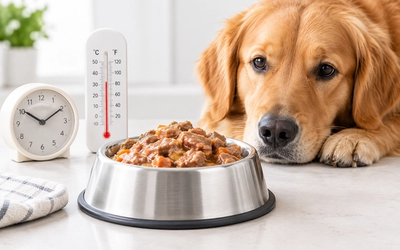
Feed by calories either way. Wet food is ~70–80% water, so the volume is much higher for the same calories. If you mix, see our guide on how long you can leave wet dog food out.
Final Thoughts
Feeding by weight is simple once you have three numbers: your dog's weight, the food's kcal/cup, and the right activity multiplier. Start with the chart, measure with a scale or marked cup, and adjust by 10% every two weeks based on body condition. That's the whole system — and it beats guessing every time.
Editor's Choice
- PetFusion Digital Pet Scale — Best overall for accurate weight tracking at home.
- Kitchen Tour Digital Kitchen Scale — Best value for precise gram-level portions.
- PetFusion Calorie Measuring Cup — Best simple upgrade for consistent scooping.